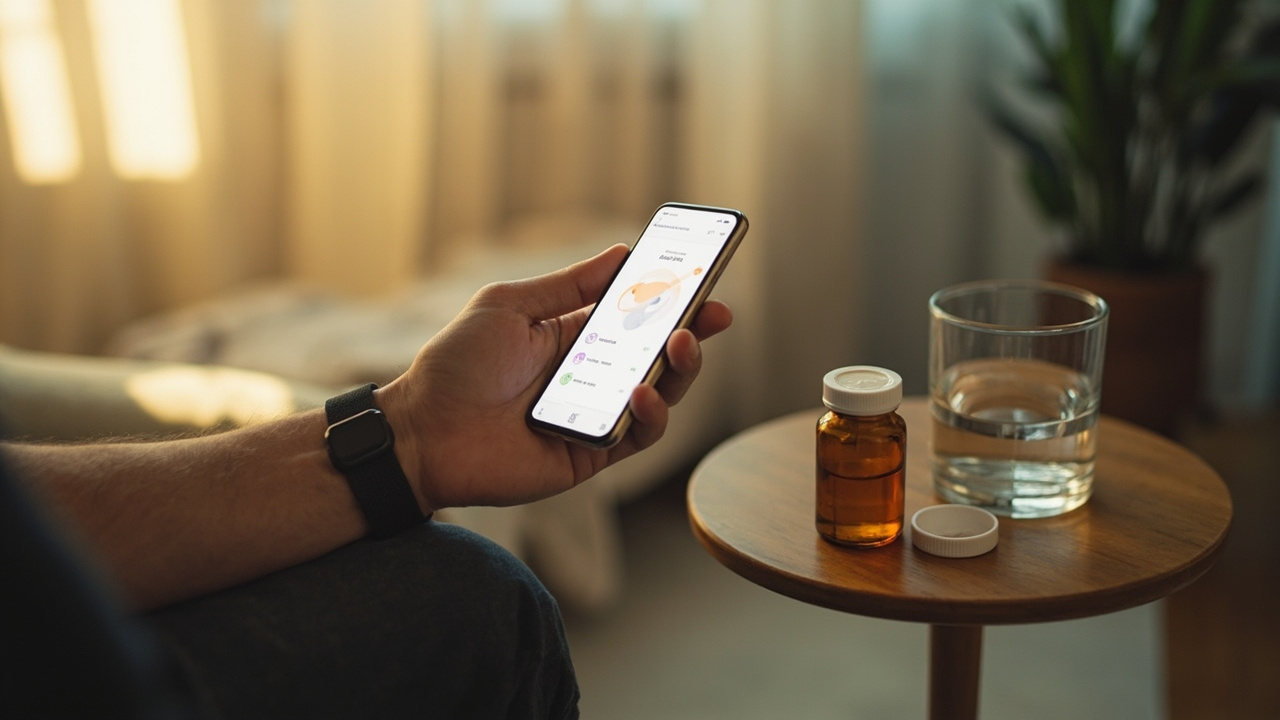
A University of Virginia pilot found that a smartphone app paired with a smartwatch could track symptoms in people taking oral targeted lung cancer drugs, and that patients' own reports came a median of 36 days before clinicians documented related adverse events.
The results, reported as abstract 2759eP in Annals of Oncology, cover 30 adults with non-small cell lung cancer (NSCLC) whose tumors carried actionable genomic alterations and who were on oral tyrosine kinase inhibitors (TKIs).
The authors note that oral TKIs bring a distinct set of adverse events that complicate symptom monitoring and care delivery. The study's aim was narrower than the 36-day figure suggests: to learn whether remote monitoring could capture symptoms as they happened, and to estimate how often symptoms and adverse events occur in this population.
The treatment team did not receive the survey results, and clinic staff assessed adverse events separately during routine visits. The authors say the impact of earlier detection, and the benefits of monitoring these patients remotely, need more research.
Feasibility, not clinical benefit, was the endpoint. The study did not test whether a care team acting on those reports changes outcomes.
How the monitoring worked
Participants were followed for up to six months — 24 weeks in the ClinicalTrials.gov listing for NCT05370469. The registry lists an Aug. 25, 2022 start and a June 14, 2024 primary completion, with a May 2026 completion date and the trial marked active, not recruiting.
Symptom data moved through Sensus, an app built at the University of Virginia for smartphones and smartwatches. It ran repeated ecological momentary assessments, short check-ins delivered during daily life, alongside digital symptom surveys issued at set intervals. The registry describes the app as capturing both active, patient-entered data and passive data from phone sensors.
The registry lists the rest of the kit: a Fitbit Sense watch and RX Cap, a pill-bottle closure with a chip that records the date and time the bottle is opened. Prompts could come at fixed times, such as three times a day, or when phone sensors picked up a possible change in the wearer's state. The watch collected steps, sleep, heart rate and exercise minutes, and paper surveys were completed during clinic visits. For patients starting treatment, visits were scheduled at screening, baseline, one week, two weeks, four weeks, eight weeks, 16 weeks and 24 weeks.
Enrollment covered two groups: patients starting a TKI or within four weeks of starting, and patients already four weeks or more into treatment. EGFR alterations accounted for 60% of the 30 participants, ALK for 23%, ROS1 for 10% and other alterations for 7%. Osimertinib was the drug for 50%, followed by alectinib (23%), mobocertinib (7%), entrectinib (7%) and other TKIs (13%).
Did patients stick with the devices?
The study set its success mark in advance: at least 66.67% of patients had to wear a smartwatch at least half the time and complete at least half of the digital symptom surveys.
Results cleared it. Eighty percent wore the watch at least 12 hours a day, 80% completed half or more of the surveys, and 73% met both targets. The authors conclude that smart-device monitoring is feasible in this group, and the study did not compare monitored patients with an unmonitored group.
Where patient reports and clinic notes diverged
Clinicians documented adverse events that were mostly grade 1 (76%), with a median duration of 54 days (interquartile range 28 to 84 days). In all nine matched symptom categories, patients logged more than clinics recorded.
| Symptom | Patient surveys (n=30) | Clinic-recorded event (n=30) | p-value |
|---|---|---|---|
| Fatigue | 24 (80.0%) | 6 (20.0%) | <0.0001 |
| Diarrhea | 23 (76.7%) | 10 (33.3%) | 0.0002 |
| Dry skin | 16 (53.3%) | 3 (10.0%) | <0.0001 |
| Paronychia | 13 (43.3%) | 5 (16.7%) | 0.0078 |
| Constipation | 13 (43.3%) | 3 (10.0%) | 0.0063 |
| Nausea | 9 (30.0%) | 1 (3.3%) | 0.0215 |
Grade 2 symptoms were reported for 40% of patients, against grade 2 adverse events for 20% (p<0.001). Rash (40.0% vs. 23.3%), edema (33.3% vs. 13.3%) and anorexia (20.0% vs. 3.3%) also favored patient reports but did not reach statistical significance.
Timing followed the same pattern. Survey symptoms arrived a median of 36 days ahead of clinic-assessed adverse events — 39.5 days for grade 1 events and 29 days for grade 2.
How to read the 36-day figure
The two streams were kept apart by design. Survey results were withheld from the treatment team, and clinic assessments were made independently, so the pilot compared what patients recorded with what routine visits captured. It did not test an alert-and-response workflow.
The sample was small and drawn from one institution, and follow-up ran up to six months. Both registry cohorts received the same monitoring package, leaving no unmonitored comparison group.
The University of Virginia is listed as the legal entity responsible for the study. Funding came from the Lung Cancer Research Foundation with funding from Pfizer, according to the abstract. Its disclosure section lists advisory board and speaking roles for several authors across drugmakers, plus institutional research grants from Pfizer to two of them.
What it means for home-based cancer care
The pilot relied on consumer products — a phone app, a fitness watch and a connected pill cap — used by patients between clinic visits. The registry lists the trial's primary purpose as supportive care, and says the results will guide future development of a mobile health system for real-time symptom monitoring, with stated goals of earlier intervention, better quality of life and fewer dose reductions or discontinuations. Those are the registry's aims; the abstract reports feasibility and symptom frequency, and its authors call for more study of benefit.
The question of benefit is being pursued elsewhere. A systematic review in JCO Oncology Practice for the 2026 ASCO Quality Care Symposium pooled 26 studies covering 4,832 patients on oral anticancer therapy. It found digital monitoring was associated with a lower risk of poor adherence (pooled odds ratio 0.60, 95% confidence interval 0.47 to 0.77), while identifying alert fatigue among clinical staff as a barrier and rating the evidence as limited by moderate risk of bias and substantial heterogeneity. That review is independent of the UVA pilot and does not evaluate the Sensus system.
The study's contribution is a measured one: consumer devices captured symptom data during home-based TKI treatment, and the reports flagged symptoms that routine visits did not capture in this cohort. Whether that earlier visibility improves tolerability or time on treatment is what the authors say still requires investigation.